
WHAT ARE WE REALLY BUYING?
The product, the story, the design – and the psychology
behind every brand we choose
By Nirali Parekh Soni | Educator, Author, Artist & Interior Designer
A phone is a phone. A shoe is a shoe. A shirt is a shirt. Strip away the branding and, on paper, most competing products solve the same problem in more or less the same way. Yet people rarely buy on function alone. They queue outside stores, defend their choice of phone the way they’d defend a football club, and feel a small thrill unwrapping a box that a rival brand’s product would never give them.
If functionality were the only reason we purchased, brand preference should be a mild, rational thing. It isn’t. So what is actually being bought when we choose one brand over an equally capable other? The product, the experience, the identity – or the story that quietly threads all three together?
The Product Is Only the Beginning
Every purchase carries more than its function. It carries an idea of who we are, or who we’d like to be seen as, the moment we own it. Marketers have long known this, but the more interesting question is a design one: how does a brand build that idea in the first place – and why does the human mind accept it so readily?
That question sits at the centre of this piece: not whether storytelling helps sell a product, but what exactly we are buying when the story, the design and the product arrive as one inseparable package.
Apple vs Samsung – A Device, or an Identity?
Apple and Samsung both make technologically capable smartphones. Few buyers can articulate a meaningful functional gap between the two once each generation settles in. Yet the two brands sit in consumers’ minds as almost different categories of feeling.
Apple’s narrative isn’t delivered through a single advertisement – it’s repeated, quietly and consistently, across product design, packaging, retail space, language and ecosystem, until the story becomes the experience of using the product at all. Samsung offers a genuine counterpoint: a different design language and a different brand proposition built around a similarly broad, capable range of devices.
“What does each brand make me feel that the specification sheet alone cannot explain?”
That is the real question worth asking of any product category – not which brand is objectively superior, but which story each one lets the buyer step into.
Nike vs Adidas – When a Slogan Becomes a World
Few brand phrases have travelled as far as Nike’s “Just Do It.” Introduced in 1988, it has evolved into something closer to a standing invitation – to begin, to try, to fail, and to keep moving – built around real athletes and their struggles rather than the shoes on their feet.
A shoe can be the product. Performance can be the function. “Just Do It” becomes the story. The buyer isn’t only purchasing footwear; the brand is offering an attitude to identify with. Adidas builds its own identity through a different mix of cultural, creative and athletic associations – proof that in the same category, two brands can tell entirely different stories around a broadly similar product.
Fabindia – Can a Product Carry Cultural Memory?
Fabindia offers a distinctly Indian version of this idea, because its narrative isn’t invented around the product – it’s embedded in how the product is made. Craft, place, makers and material carry the story before a single word of marketing copy is written.
This raises a sharper question for visual narrative: what happens when texture, colour, store environment and language do the storytelling, drawing on associations shoppers already hold about Indian material culture? And a fair one too – at what point does a genuine craft story risk being simplified or romanticised for a contemporary shelf?
Dior – When Heritage Becomes Experience
Luxury brands push this further still. A house like Dior treats heritage not as a fact to state but as a world to keep renewing – architecture, art, craftsmanship and place woven together so the physical environment itself becomes part of the story, not merely the setting for it.
Luxury, in this reading, is never only the material or the craftsmanship of an object. It’s the world built around it – through space, sequence, ritual and code – until the question becomes whether the story itself has quietly become part of what the customer is paying for.
What Actually Creates Value?
Rather than treating product, storytelling and marketing as separate ingredients, it helps to see them as a single layered chain:
PRODUCT – what it actually does
DESIGN – how it looks, feels, and functions
NARRATIVE – what it means
MARKETING – how that meaning is communicated
EXPERIENCE – how the promise is encountered
MEMORY – what remains
IDENTITY – what it says about the person who owns it
This chain guards against a lazy claim – that “good storytelling sells.” A powerful narrative cannot indefinitely prop up a poor product. But a strong product with no coherent narrative behind it often stays unnoticed, undifferentiated, forgettable. The interesting territory is the relationship between the two.
The Designer’s Eye: Narrative Without a Single Word
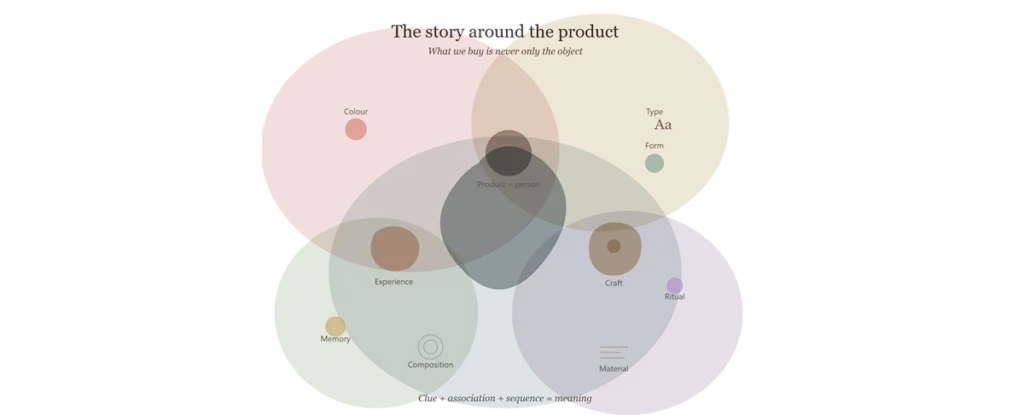
Narrative doesn’t have to be written down. A brand can tell its story through colour, form, typography, material, scale, composition, repetition, contrast, imagery, packaging, spatial sequence, sound and ritual – the full vocabulary a designer already thinks in.
VISUAL NARRATIVE = CLUE + ASSOCIATION + SEQUENCE + MEANING
A viewer rarely receives a complete story in a single glance. Instead, the mind gathers clues, compares them against past experience, forms associations, and gradually assembles meaning – which is exactly why visual narrative matters more, not less, in a world where people meet brands through scattered, fragmented touchpoints rather than one long advertisement.
Why Does the Mind Respond to Story at All?
The pull of narrative isn’t just a marketing trick – it’s arguably how the human mind is built to process experience in the first place. Decades of work in narrative psychology and consumer research point to a few consistent threads: stories transport us emotionally, structure how we remember things, and shape the associations we form almost automatically, well before conscious reasoning kicks in. Emotion, in turn, plays a far larger role in decision-making than most of us assume.
Which raises the sharper question: does narrative work because brands have simply become better storytellers – or because the human mind is naturally inclined to organise the world through meaning, association and story, and brands have only learned to speak that native language?
When Story Becomes Manipulation
Every contemporary brand seems to have a story now – authentic, sustainable, artisanal, local, purposeful, heritage-driven. Which leaves an uncomfortable but necessary question: when is narrative a genuine expression of a brand, and when is it simply a device built to manufacture a perception the brand hasn’t earned?
A story can create attention. A story can create emotional connection. A story can create memory. But the experience has to eventually validate the story – storytelling can’t be treated only as a persuasion tool. The strongest narratives tend to emerge from something real within the product, the organisation or the culture behind it, not the other way around.
From Brand Story to My Story
Perhaps we don’t choose brands simply because of their stories. We choose them because their stories can become part of our own – the clothes we wear, the objects we keep, the phone we carry, the spaces we inhabit. Each becomes a small fragment of identity.
“A successful brand doesn’t just tell us its story. It gives us a story we want to be part of.”
Put more provocatively: perhaps the most powerful brands aren’t the ones that tell us who they are. They’re the ones that help us tell ourselves who we are – one product, one design choice, one narrative clue at a time.
ABOUT THE AUTHOR
Nirali Parekh Soni is an educator, author, artist and interior designer whose work explores the relationship between people, perception and designed environments. Her interests move across visual narrative, spatial storytelling, design education, art, materiality and the psychology of seeing – and how people read visual clues, build associations, and turn information into meaning. As an educator she works at the intersection of design thinking and visual communication; as an artist she investigates perception through colour, line and visual expression; as an interior designer she studies how material, light, scale and spatial sequence shape experience; and as an author she writes about design not only as something we create, but as something that shapes the way we see and live.
Sources
- Green, M. C., & Brock, T. C. (2000). The role of transportation in the persuasiveness of public narratives. Journal of Personality and Social Psychology, 79(5), 701–721.
- Escalas, J. E. (2007). Narrative processing: Building consumer connections to brands. Journal of Consumer Psychology, 17(1), 36–43.
- Kahneman, D. (2011). Thinking, fast and slow. Farrar, Straus and Giroux.
- Harper’s Bazaar India. (2022, September 17). How Fabindia put Indian craftsmanship on the global fashion map. https://www.harpersbazaar.in/culture/story/how-fabindia-put-indian-craftsmanship-on-the-global-fashion-map-564425-2022-09-17
- Wallpaper*. (2022, August 18). Inside 30 Avenue Montaigne, Dior’s new Parisian flagship. https://www.wallpaper.com/fashion/dior-30-avenue-montaigne-paris-store-museum